
September 23, 2026
Fall is coming to the Hill Country. Here's what to know about pool heater repair, installation, and getting your system ready before the water turns cold.
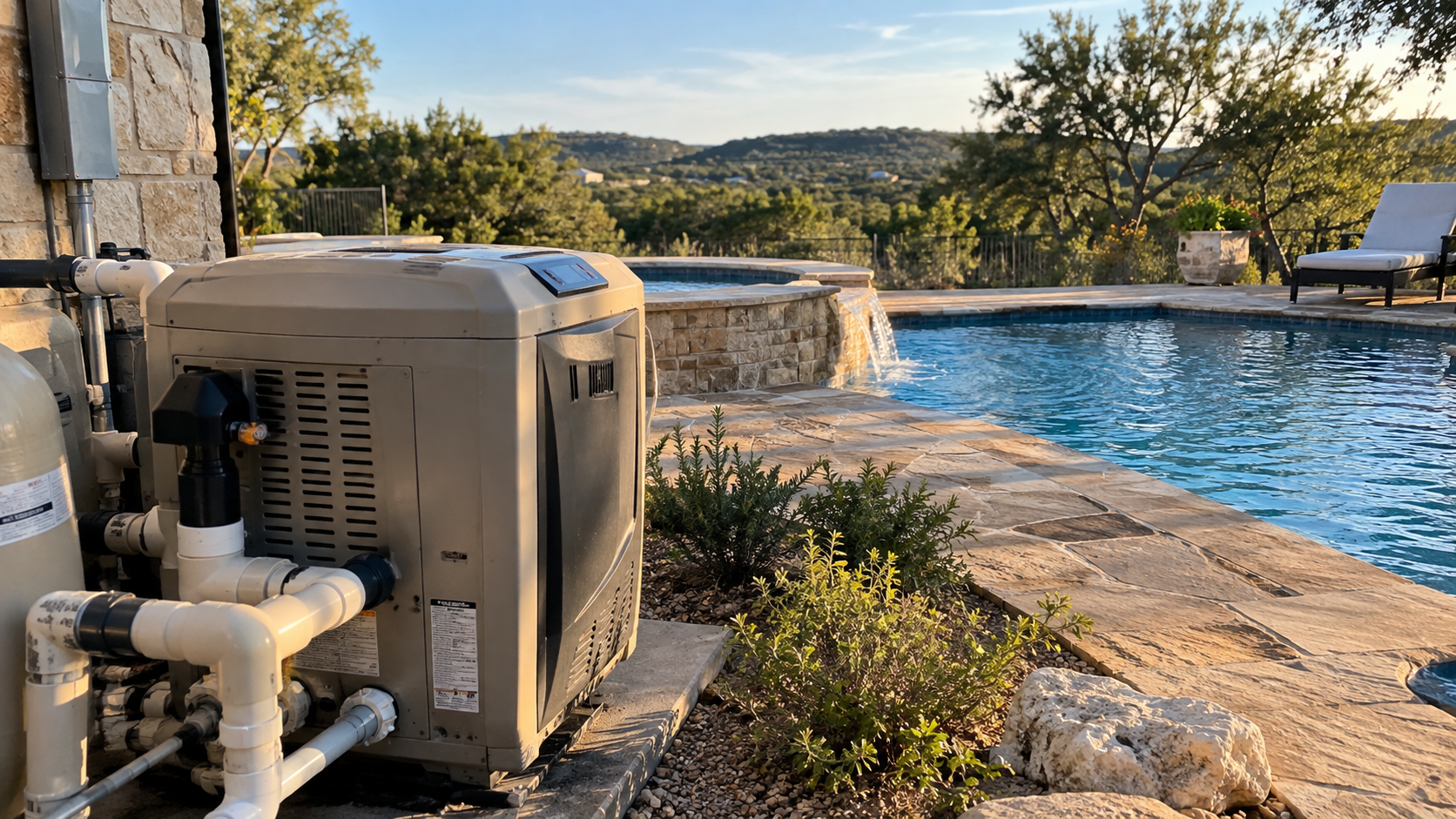
Fall arrives quietly in the Texas Hill Country. One week you are swimming in 95-degree heat, and the next the evenings are dropping into the 50s and the pool that felt refreshing in August suddenly feels like a cold plunge. For homeowners and vacation rental operators across Fredericksburg, Kerrville, Boerne, Bandera, Canyon Lake, and the broader Hill Country, a pool heater is what separates a pool you use nine months a year from one that sits idle from October through March. Blue Olive Pools handles pool heater repair and installation across the Texas Hill Country, and fall is exactly the right time to make sure your system is ready.
Most Hill Country homeowners do not think about the pool heater until the water is already cold. That is understandable, but it creates a predictable problem every October. Heater repair and installation requests spike right when everyone realizes their system is not working, which means longer wait times and the possibility of missing weeks of comfortable swimming while you wait for service.
Getting ahead of the season accomplishes two things. First, it gives you time to diagnose and fix any issues before you need the heater daily. Second, it keeps your pool usable through what is genuinely some of the best swimming weather of the year in the Hill Country. October and November days here are often perfect: warm enough to enjoy the water, cool enough that you are not fighting the sun. A properly functioning heater makes those months an extension of swim season rather than the end of it.
For short-term rental operators across the Hill Country, a working heater is not optional. Guests booking a property with a pool in October through February expect the water to be swimmable. A heater that fails during a guest stay creates a bad review, a refund conversation, and a property management headache that a pre-season service call would have avoided entirely.
Understanding the options helps you make the right choice when repair costs need to be weighed against replacement.
Gas heaters are the most common option for pools in the Texas Hill Country, and for good reason. They heat water quickly regardless of the ambient air temperature, which makes them well-suited for the Hill Country's climate where you might need to heat a cold pool in a hurry for an incoming guest or a weekend gathering. A gas heater can raise pool temperature several degrees per hour, which means you can go from cold to swimmable in a reasonable timeframe.
The tradeoff is operating cost. Gas heaters are not efficient on a per-BTU basis compared to heat pumps. For pools that are heated occasionally and need to warm up fast, gas is often the right tool. For pools that are maintained at a consistent temperature year-round, the operating cost adds up.
Gas heaters work on either natural gas or propane. Most rural Hill Country properties without access to a natural gas line use propane, which is delivered by tank. Propane availability and tank management add a logistical layer that natural gas connections do not require.
Heat pump heaters extract heat from the ambient air and transfer it to the water. They are significantly more efficient than gas heaters on a per-BTU basis, and they make the most sense for pools that are heated consistently throughout the season rather than on demand.
The limitation in the Hill Country is that heat pump efficiency drops as ambient air temperature falls. Most heat pumps operate effectively down to around 45 to 50 degrees Fahrenheit. On cold Hill Country nights, particularly in January and February, a heat pump may struggle to maintain temperature or may not operate at all. For a pool that needs to be swim-ready during a cold snap, a heat pump alone may not be sufficient.
Many Hill Country pool owners use a combination approach: a heat pump for the shoulder seasons when temperatures are mild and a gas heater as backup for colder periods. This keeps operating costs down during most of the season while maintaining the ability to heat quickly when conditions call for it.
Solar heating systems use dedicated roof or rack-mounted panels to capture heat from the sun and transfer it to the pool water. They have the lowest operating cost of any heater type because sunlight is free. The Hill Country's sunny climate makes solar a legitimate option, and a well-designed solar system can extend swim season meaningfully in spring and fall.
The limitations are that solar systems do not heat quickly and depend entirely on sun exposure. On cloudy days or during cold nighttime temperatures, a solar system provides little to no heating. Solar works best as a supplement to extend the season at the margins, not as a standalone solution for year-round heated swimming in the Hill Country.
Do not wait until the water is cold to find out your heater has a problem. These are the signs worth investigating now:
The heater runs but the water temperature does not rise. This can indicate a failing heat exchanger, a gas supply issue, a refrigerant problem in a heat pump, or a flow rate issue where the pump is not moving enough water through the heater. The cause varies by heater type but all of them require diagnosis before the season.
The heater ignites and then shuts off quickly. A heater that lights and then cuts out is often a flame sensor, pressure switch, or venting issue. On gas heaters, this behavior can also indicate an issue with the gas pressure or a partially obstructed burner.
Error codes on the control panel. Modern pool heaters display error codes that narrow down the issue significantly. Note the code and call for service. Trying to clear a code without addressing the underlying cause typically results in the same error returning.
The heater has not been serviced in several years. Even a heater that appears to be working can have burner scale, corroded components, or a heat exchanger that is losing efficiency. A pre-season inspection catches these issues before they become failures.
The heater is more than 10 years old. Gas pool heaters typically last 8 to 12 years with proper maintenance. A heater in that age range that has not been recently serviced deserves a professional assessment before another season. Replacing an aging heater proactively is almost always less disruptive and less expensive than an emergency replacement mid-season.
If your heater needs replacing or you are adding a heater to a pool that does not have one, here is what to expect from the process.
Sizing. Heater sizing is based on pool volume, the desired temperature rise, and how quickly you need the pool to heat. An undersized heater runs constantly, costs more to operate, and never quite gets the pool to temperature. An oversized heater costs more upfront than necessary. Blue Olive Pools sizes heaters correctly for your pool and your usage pattern before making a recommendation.
Fuel connection. For gas heaters, the installation requires a properly sized gas line from the supply to the equipment pad. If you are adding a gas heater to a pool that previously had only a heat pump or solar system, this may involve running a new line. For propane, the tank size and regulator need to match the heater's BTU demand.
Equipment pad configuration. The heater connects into the existing plumbing system at the equipment pad, typically after the filter and before the return line. The installation needs to account for proper flow rates and bypass valves that allow the heater to be isolated for service without shutting down the rest of the system.
Permits. Gas appliance installations in Texas require permits in many jurisdictions. Blue Olive Pools handles the permitting process as part of the installation so you are not navigating the paperwork yourself.
Timeline. A straightforward heater replacement at an existing connection point can typically be completed in a single day. New gas line runs and more complex installations take longer. We provide a clear timeline before any work begins.
A pool heater that is properly set up and used correctly costs significantly less to operate than one that is working harder than it needs to.
Use a pool cover. Heat loss overnight is one of the biggest operating cost drivers for a pool heater. A solar or thermal cover that sits on the water's surface retains heat that the heater put into the water, which means less run time the next morning to get back to temperature. For STR operators and vacation rental properties, a cover also keeps debris out of the water between guest stays.
Set a target temperature and hold it. Repeatedly heating a pool from cold is more expensive than maintaining a consistent temperature. For a pool in regular use, maintaining a consistent setpoint is typically more efficient than shutting the heater off between uses and reheating.
Keep the filter clean. A dirty filter restricts flow through the heater, which reduces efficiency and can trigger flow-related error codes. Regular filter cleaning is particularly important during the fall when leaves and debris increase the load on the filter.
Service the heater annually. A pre-season inspection that cleans the burner, checks the heat exchanger, verifies gas pressure, and confirms all safety switches are functioning properly keeps the heater running at rated efficiency and catches small issues before they become failures.
Sizing depends on your pool's volume, the target temperature, and how quickly you need to heat it. As a general rule, most residential pools in the 15,000 to 30,000 gallon range are served well by heaters in the 300,000 to 400,000 BTU range for gas. Larger pools or pools that need to heat quickly may need more capacity. Blue Olive Pools sizes every heater installation to the specific pool and usage pattern.
At typical fall ambient temperatures in the 60s and 70s, a properly sized gas heater can raise a pool's temperature by 1 to 2 degrees per hour. Starting from 65 degrees and targeting 82 degrees would take roughly 8 to 10 hours on a single heater. Heat pumps are slower in cooler conditions. Planning a heat-up overnight before a morning swim or guest arrival is the most practical approach.
Yes. Adding a heater to an existing pool involves connecting the unit into the existing plumbing at the equipment pad and establishing the appropriate fuel supply. If the pool has an existing gas line nearby, the installation is relatively straightforward. If a new gas line is needed, that adds scope to the project. Blue Olive Pools assesses the existing setup and gives you a clear picture of what is involved before committing to anything.
The general rule is that if a heater is under 8 years old and the repair cost is less than half the replacement cost, repair makes sense. If the heater is 10 or more years old or repair costs approach replacement costs, replacement is usually the better investment, particularly heading into a new season when reliability matters. Blue Olive Pools gives you an honest assessment of both options before recommending one over the other.
Yes. Blue Olive Pools serves pool heater repair and installation across the Texas Hill Country including Fredericksburg, Kerrville, Boerne, Bandera, Canyon Lake, New Braunfels, Marble Falls, Horseshoe Bay, Comfort, Wimberley, Dripping Springs, Hondo, Uvalde, and surrounding communities.
Blue Olive Pools handles pool heater repair, installation, and pre-season inspections for residential homeowners, vacation rental operators, HOAs, and commercial properties across the Texas Hill Country. Do not wait until the water is cold and the schedule is full. Contact us at (830) 222-6211 or reach out online for a free estimate and get your heater sorted before the season turns.