Short answer: If your pool drops more than about 1/4 inch a day, or drops faster than a bucket of pool water sitting next to it, you likely have a leak, not just evaporation. The bucket test below is free and takes 24 hours.
How much water does a pool lose to evaporation?
In the Texas Hill Country and south Texas, hot afternoons, low humidity, and steady wind pull water out of pools fast, especially from June through September. On the hottest, windiest days, evaporation alone can come close to 1/4 inch a day. Water features, waterfalls, spillover spas, and heaters all add to it.
That's why guessing doesn't work. A pool that loses 1/4 inch in August might be perfectly fine. The same loss in November is a red flag.
The bucket test: a free way to check
- Set a 5-gallon bucket on the first or second step of the pool so it sits in the sun like the pool does.
- Fill the bucket with pool water until the level inside matches the pool level outside.
- Mark the water line inside the bucket and the pool level on the outside of the bucket.
- Run your pump on its normal schedule for 24 hours. Don't add water or let the auto-fill run.
- Compare. If the pool dropped more than the bucket, you likely have a leak.
- Repeat with the pump off for 24 hours. If the pool loses more with the pump running, the leak is likely in the pressure-side plumbing. If it loses more with the pump off, look at the suction side or the shell.
Other signs of a leak
- The auto-fill runs constantly, or your water bill jumps
- Wet or soft spots in the yard, or water near the equipment pad
- Cracks in the plaster, loose tiles, or gaps around skimmers and lights
- Air bubbles in the pump basket or return jets
- Algae that keeps coming back because fresh water keeps diluting the chemistry
- The water level stops dropping at the same spot, like the bottom of the skimmer or a light
Why it matters
One inch of water on a 15-by-30-foot pool is roughly 280 gallons. A slow leak can waste thousands of gallons a month and, over time, wash out soil under the deck or shell. Catching it early is almost always cheaper.
What to do next
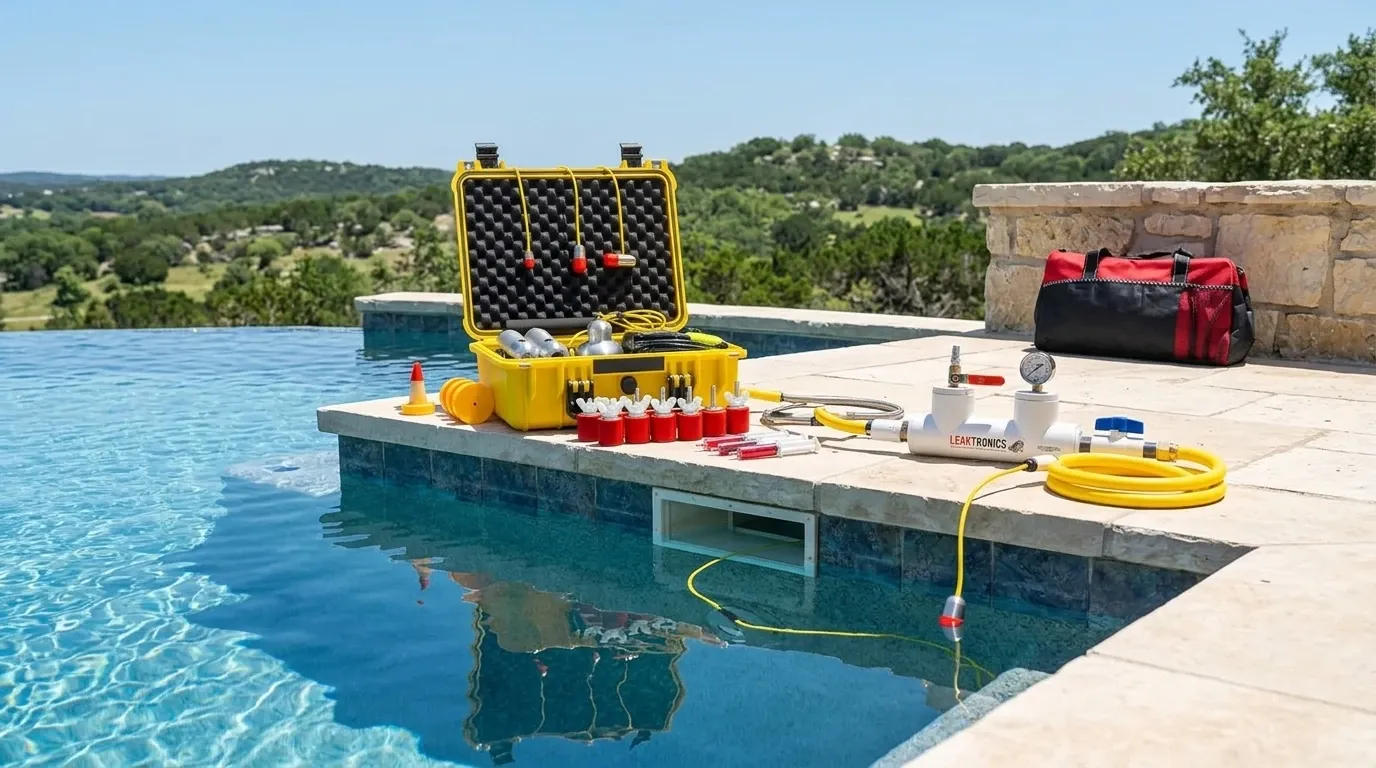
If the bucket test points to a leak, our pool leak detection service finds the source with electronic listening equipment, dye testing, and pipe cameras, then we fix it in-house. Residential leak detection starts at $495. We serve the Hill Country and south Texas, including Uvalde, Kerrville, Boerne, and north San Antonio. See all service areas.
Cell service is spotty where we work, so the fastest way to reach us is a text to 830-222-6211, an email, or our contact form.
Note: we don't perform leak detection or leak repair on fiberglass pools.
{"@context":"https://schema.org","@graph":[{"@type":"Article","headline":"Is My Pool Leaking or Just Evaporating? A Hill Country Guide","datePublished":"2026-10-18","author":{"@type":"Person","name":"Tommy Adams","jobTitle":"Co-owner, LeakTronics certified, Certified Pool Operator"},"publisher":{"@id":"https://www.blueolivepools.com/#localbusiness","@type":"LocalBusiness","name":"Blue Olive Pools"},"mainEntityOfPage":"https://www.blueolivepools.com/posts/is-my-pool-leaking-or-evaporating"},{"@type":"FAQPage","mainEntity":[{"@type":"Question","name":"How do I know if my pool is leaking or evaporating?","acceptedAnswer":{"@type":"Answer","text":"Do a 24-hour bucket test. Set a bucket of pool water on a pool step, mark both water levels, and compare after 24 hours. If the pool drops more than the bucket, or more than about 1/4 inch a day, you likely have a leak."}}]}]}