August 25, 2026
What Hill Country HOA boards need to know before signing a pool service contract for community amenities.
A community pool that looks great on paper can turn into a headache fast if the service contract behind it has gaps. Boards find this out the hard way, usually after a resident complaint, a surprise repair bill, or a pool that closes right before a holiday weekend.
Blue Olive Pools works with HOAs and community associations across the Texas Hill Country, and the pattern we see most often is the same. A board signs a contract built for a single backyard pool, not a shared amenity used by dozens of families, and the gaps show up within the first season. A pool service contract for an HOA needs to cover more ground than a standard residential agreement, and knowing what to look for before signing saves boards real money and real headaches.
A residential pool serves one household with fairly predictable use. A community pool serves an entire neighborhood, which means heavier bather load, more variable usage patterns, and a lot more at stake if something goes wrong.
Boards are also accountable to residents in a way a single homeowner isn't accountable to anyone. A cloudy pool or a broken pump doesn't just inconvenience one family. It generates complaints, emails to the board, and sometimes formal grievances at the next meeting.
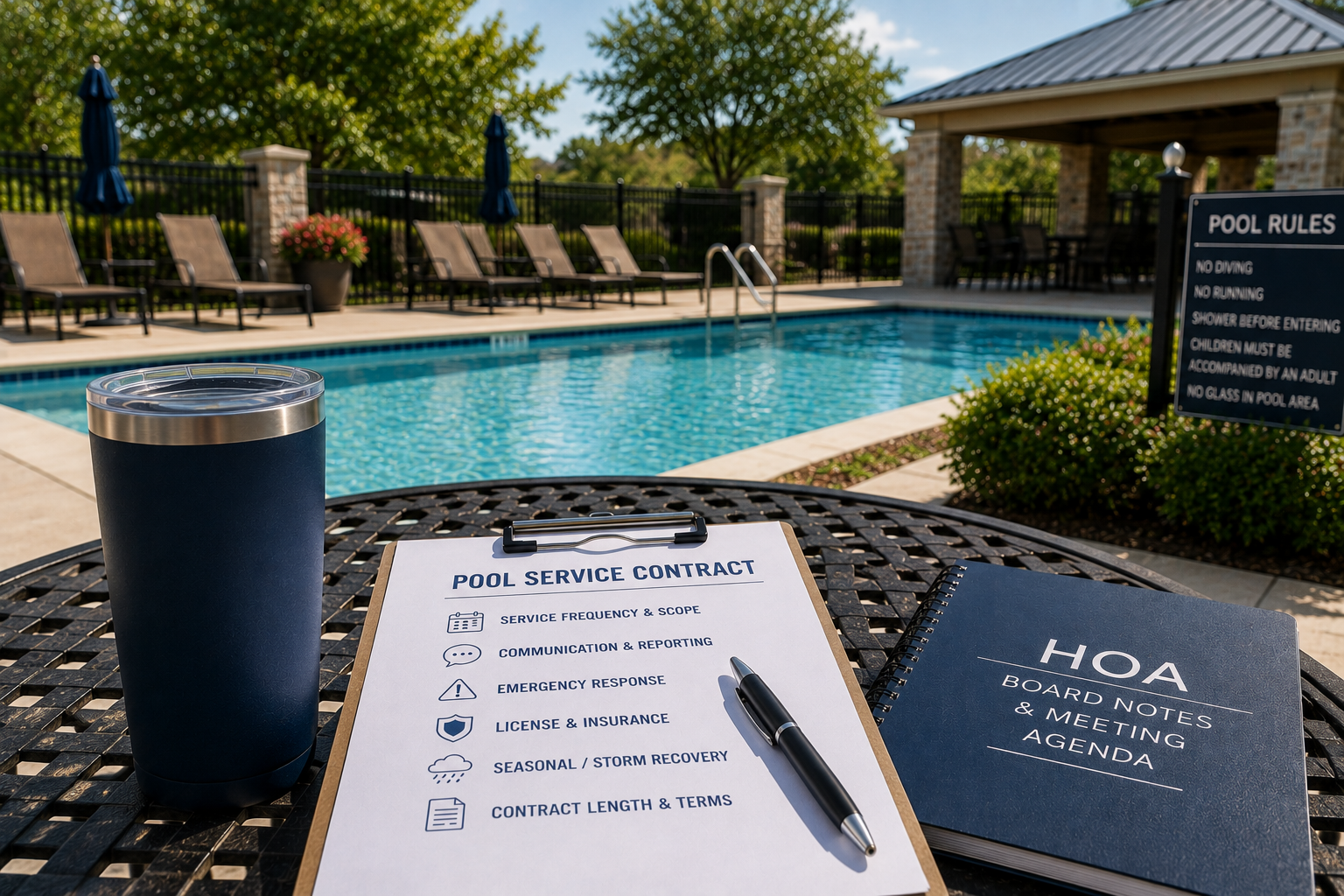
The first thing to check in any HOA pool contract is exactly what's included and how often it happens.
If a contract is vague about frequency and scope, that vagueness tends to show up later as a dispute over what should have been covered.
Boards manage a lot, and most board members aren't at the pool daily to see how it's actually running. A contract should spell out how the service provider keeps the board informed.
Ask whether the provider offers documented service reports after each visit. Photo documentation in particular gives boards a paper trail if a resident disputes whether service happened or what condition the pool was in.
Also worth asking: how does the provider handle communication when something needs board approval, like a repair beyond routine maintenance? A contract that spells out an approval process ahead of time prevents confusion when a real decision needs to be made quickly.
Equipment doesn't wait for a convenient time to fail, and a community pool with broken equipment on a Saturday during peak season is a different kind of problem than a backyard pool in the same situation.
A contract that's silent on emergency response usually means the board finds out the hard way what the actual response time is.
This is the section boards sometimes skim past, and it's the one that matters most if something goes wrong.
Confirm the provider is properly licensed and insured for commercial or shared-amenity work, not just residential service. In Texas, that means checking for TDLR licensing specifically. Ask to see proof of liability coverage, and confirm the coverage amount is appropriate for a community pool, not a single residential account.
Boards should also understand who's liable if an issue with water chemistry or equipment leads to an injury or illness. A vague or missing liability section in a contract is a real exposure for the association, not just an inconvenience.
Hill Country weather brings real risk to community pools, from summer storms to unexpected flooding. A strong contract addresses how the provider handles these situations, not just routine maintenance.
Finally, boards should read the fine print on how long the contract runs and what it takes to end it if the relationship isn't working.
Understand the notice period required for cancellation, and whether that period is reasonable for a board that meets monthly or quarterly. A 60-day cancellation notice is common for commercial accounts, but boards should confirm this rather than assume it matches a residential agreement.
Community pools generally need more frequent service than residential pools due to higher bather load and usage. Many Hill Country associations move to more frequent visits during peak season, with the exact schedule depending on pool size and community usage patterns.
In Texas, look for TDLR licensing along with appropriate liability insurance coverage for commercial or shared-amenity properties, not just standard residential coverage.
Most boards set a dollar threshold below which the service provider can proceed with repairs directly, with anything above that threshold requiring board approval. This should be clearly outlined in the contract to avoid delays during time-sensitive issues.
The contract should specify expected response times for equipment failures, whether emergency response is included or billed separately, and who has authority to approve urgent repairs outside normal business hours.
Given the flood risk across parts of the Hill Country, contracts should address water testing, equipment inspection, and cleanup support after severe weather, not just routine maintenance.
Boards should ask for documented service reports, ideally with photos, after each visit. This creates a clear record for the board and helps address any resident questions about pool condition or service history.
If your HOA's current pool contract leaves questions unanswered about service scope, emergency response, or liability, it may be time for a closer look. Contact Blue Olive Pools to discuss a service plan built for community pools across the Texas Hill Country.